

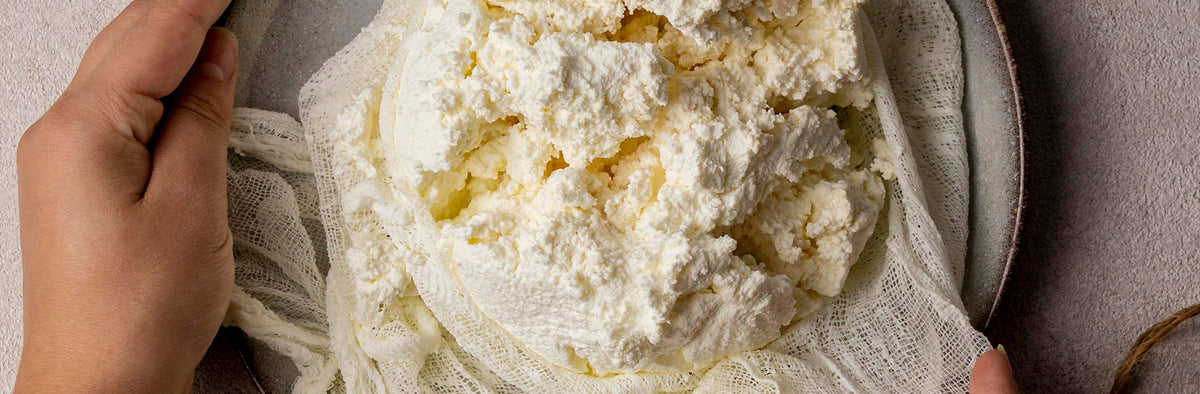
What You Will Need
This recipe makes approximately 1–2 cups of whey ricotta.
- 7½ litres of fresh whey, no more than three hours old
- 1½ litres of full-cream milk for an increased yield
- ¼ cup cider vinegar
- Cheesecloth or butter muslin
- Colander
- ½ teaspoon cheese salt; optional
- ½ teaspoon herbs; optional
Method
Clean and Sterilise
Thoroughly clean and sterilise everything that will be used during the cheese-making process.
Heat the Whey
Pour the fresh whey into a large pot.
Add the full-cream milk if you would like to increase the yield.
Heat the mixture to 93°C.
Add the Vinegar
While stirring, turn off the heat and add the cider vinegar.
Tiny white particles of albuminous protein should begin to form.
Drain the Curds
Carefully ladle the curds into a colander lined with cheesecloth or butter muslin.
Allow the curds to drain.
Hang the Cheese
Once the cloth is cool enough to handle, tie the corners together in a knot.
Hang the cloth over the sink and allow the cheese to drain for several hours.
Season the Ricotta
Once the cheese has stopped draining, untie the cloth and place the ricotta into a bowl.
Add cheese salt to taste, along with herbs if desired.
Store the Ricotta
Cover the bowl and refrigerate the ricotta for up to one week.
Whole Milk Ricotta
What You Will Need
This recipe makes approximately 900 g of whole milk ricotta.
- 3½ litres of full-cream milk
- 1 teaspoon citric acid dissolved in ¼ cup of water
- Cheesecloth
- ½ teaspoon cheese salt; optional
- 1–2 tablespoons thickened cream; optional
Method
Clean and Sterilise
Thoroughly clean and sterilise everything that will be used during the cheese-making process.
Prepare the Milk
Add the citric acid solution and cheese salt, if using, to the milk.
Mix thoroughly.
Heat the Milk
Pour the milk into a large pot and heat it directly to 85–90°C.
Do not allow the milk to boil.
Stir regularly to prevent the milk from scorching on the bottom of the pot.
Allow the Curds to Form
As soon as the curds and whey separate, check that the whey is no longer milky.
Turn off the heat and allow the mixture to sit undisturbed for 10 minutes.
Drain the Curds
Line a colander with cheesecloth and carefully ladle the curds into it.
Tie the corners of the cheesecloth together in a knot.
Hang the bag and allow the cheese to drain for 20–30 minutes, or until it reaches your preferred consistency.
Finish the Ricotta
The ricotta is ready to eat immediately.
For a creamier consistency, add 1–2 tablespoons of thickened cream and mix thoroughly.
Store the Ricotta
Transfer the ricotta to a covered container and refrigerate for one to two weeks.